30 Palazzo-Style Luxury Bathrooms
Experience the elegance of Italy’s grand palaces with 30 meticulously crafted Palazzo-style bathrooms. Each design blends historical authenticity with modern luxury, featuring marble floors, frescoed ceilings, sculptural stone tubs, and classical architectural detailing. From Renaissance symmetry to Baroque drama, these spaces celebrate proportion, light, and craftsmanship, transforming private bathrooms into serene, opulent retreats.
Grand Palazzo Bathroom Inspired By Italian Renaissance Architecture
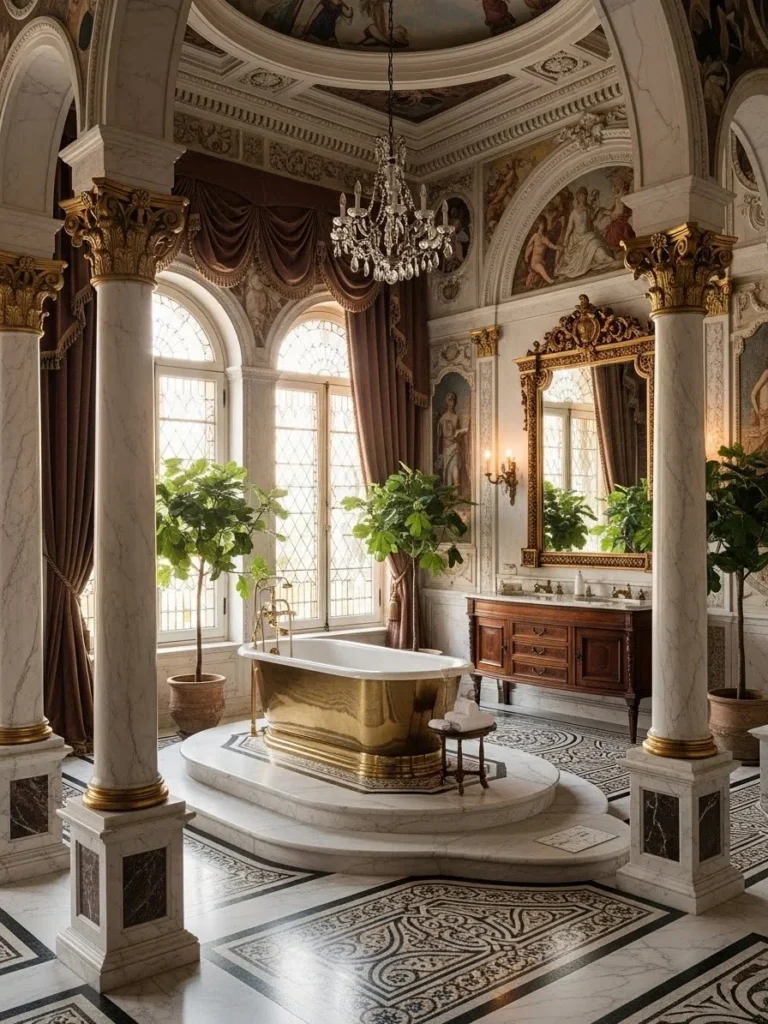
This bathroom is conceived as a faithful interpretation of Italian Renaissance palazzo interiors, where proportion, symmetry, and material hierarchy defined luxury. The spatial composition emphasizes balance, with axial alignment guiding the eye from entrance to bathing area. Load-bearing stone walls and classically derived proportions evoke the architecture of fifteenth- and sixteenth-century Florentine residences, translated into a private bathing environment.
Marble flooring, laid in large-format slabs, reflects historical usage of Carrara stone in noble homes, while fluted columns articulate the space without overwhelming it. These columns are structural in appearance, echoing Renaissance ideals rather than purely decorative classicism. Arched windows follow traditional masonry openings, admitting soft daylight filtered through linen or wooden shutters.
Fixtures are restrained and historically sympathetic, using brass and patinated metals rather than overt ornamentation. The freestanding bathtub is sculptural yet grounded, resembling carved stone basins used in palatial bathing chambers. Ornamentation remains secondary to architectural order.
Light plays a crucial role, enhancing surface textures and reinforcing depth. The overall atmosphere communicates restrained opulence, rooted in Renaissance ideals of harmony, geometry, and permanence rather than excess.
Luxury Palazzo Bathroom With Carrara Marble Walls
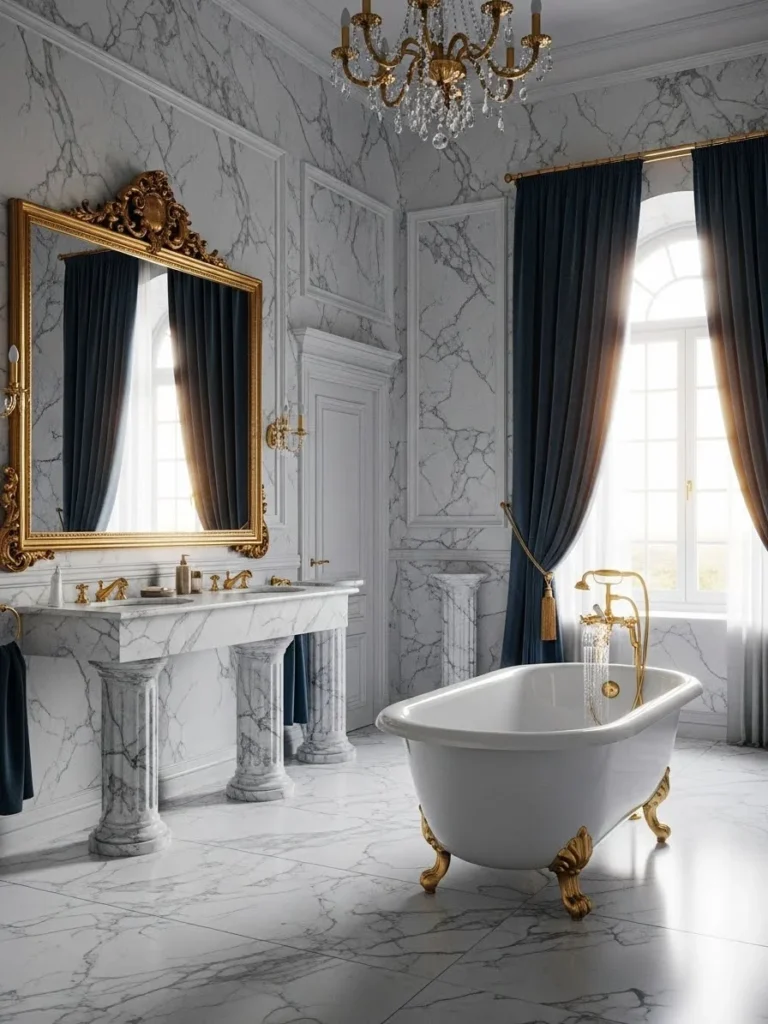
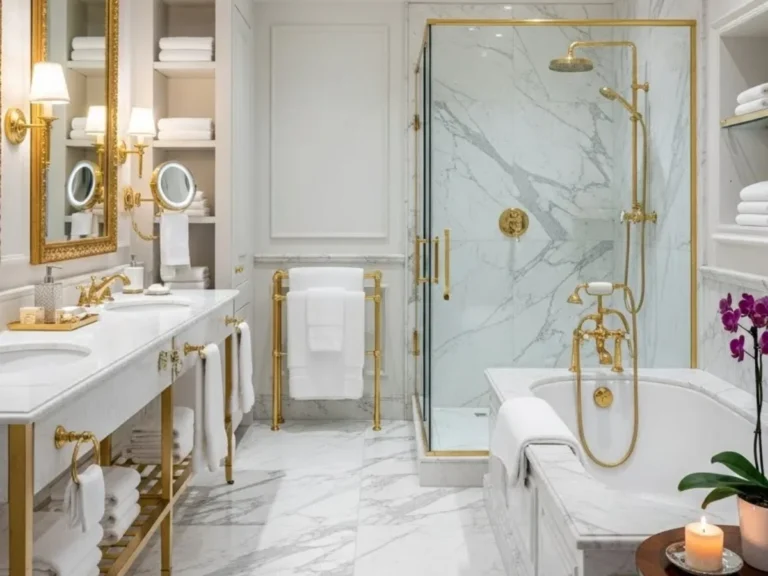
This bathroom centers on Carrara marble as both a structural and aesthetic element, reflecting its historical importance in Italian palazzi. Walls are clad in book-matched marble slabs, emphasizing natural veining rather than applied decoration. The design follows Renaissance principles where material quality conveyed wealth and status more than ornament.
The layout is symmetrical, with a centrally placed soaking tub aligned along the primary axis of the room. Classical wall articulation—subtle pilasters and recessed panels—creates rhythm while maintaining architectural discipline. Cornices and moldings are derived from Renaissance interior detailing, scaled appropriately for a private space.
Gold-accented fixtures reference historical gilded bronze fittings without becoming baroque. Their restrained profiles ensure visual continuity with the architectural shell. The bathtub’s form is inspired by stone sarcophagi and historical bathing vessels, grounding it in precedent rather than contemporary minimalism.
Lighting is intentionally soft and indirect, replicating daylight conditions found in historic palazzi. The resulting space feels monumental yet calm, demonstrating how Renaissance luxury relied on proportion, material authenticity, and craftsmanship rather than decorative excess.
Italian Palazzo-Style Master Bathroom With Fresco-Painted Ceilings
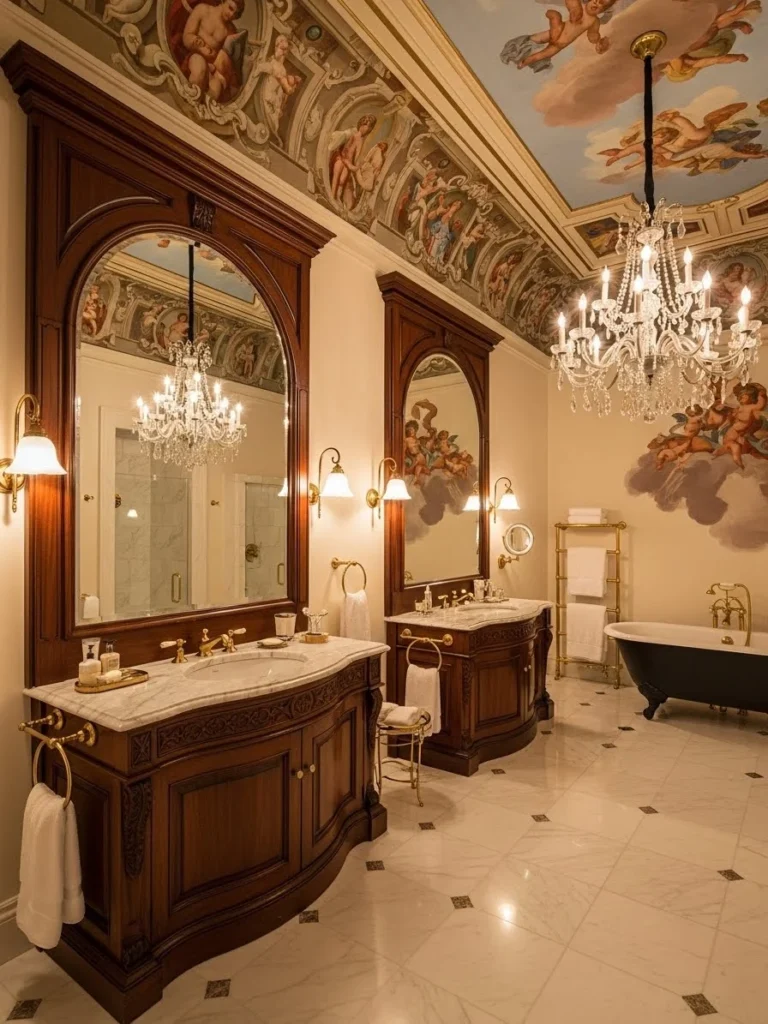
This master bathroom draws directly from the tradition of frescoed ceilings found in Renaissance palazzi, where art and architecture were inseparable. The ceiling becomes the dominant feature, painted with historically informed motifs such as grotesques, allegorical figures, or ornamental geometry, executed in muted mineral pigments consistent with period techniques.
Below, the architecture remains deliberately restrained to support the painted surface. Walls are finished in lime plaster or lightly veined stone, maintaining material authenticity. Large arched mirrors reference the scale and curvature of Renaissance openings, enhancing spatial depth without modern exaggeration.
Antique brass fixtures echo historically accurate metalwork, with simple profiles and visible craftsmanship. Vanities resemble furniture-like stone consoles rather than contemporary cabinetry, reinforcing the idea of permanence. The bathtub is positioned to maintain axial balance within the room.
Lighting is layered carefully to avoid competing with the fresco. Concealed sources wash the ceiling gently, preserving its painterly quality. The space ultimately functions as both a private bathroom and a continuation of palatial interior tradition.
Palace-Inspired Bathroom With Roman Columns And Checkerboard Marble Floors
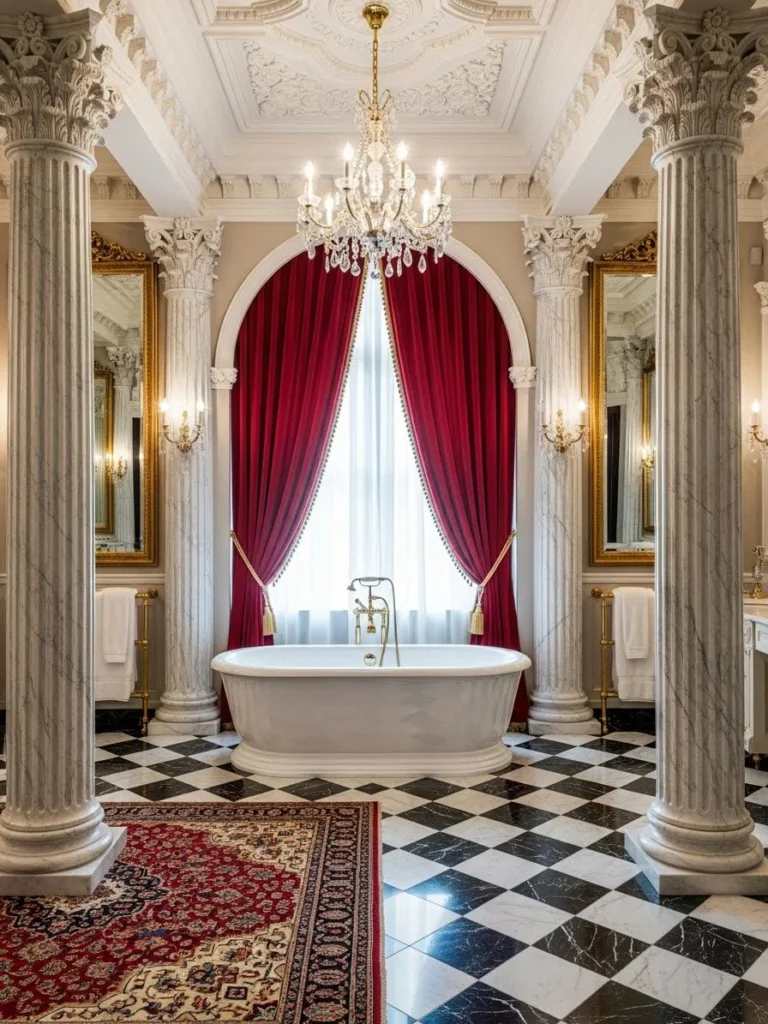
This bathroom references both Renaissance palazzi and their Roman precedents, particularly in the use of classical columns and geometric flooring. The checkerboard marble floor derives from Roman and early Renaissance interiors, providing visual order and durability. The pattern reinforces spatial hierarchy and axial clarity.
Roman-style columns frame the bathing area, functioning as architectural dividers rather than decoration. Their proportions follow classical orders, scaled to the interior volume. Walls are finished in smooth stone or plaster, allowing the floor and columns to carry visual weight.
The soaking tub is placed centrally, echoing Roman bathing traditions while maintaining Renaissance symmetry. Fixtures are minimal and historically informed, avoiding modern forms that would disrupt architectural coherence. Ornamentation is expressed through form and material rather than applied detail.
Natural light enters through tall openings, emphasizing contrast between light and shadow. The resulting environment feels monumental, disciplined, and rooted in classical tradition, translating palace-scale architecture into an intimate but dignified bathing space.
Venetian Palazzo Luxury Bathroom With Terrazzo Flooring
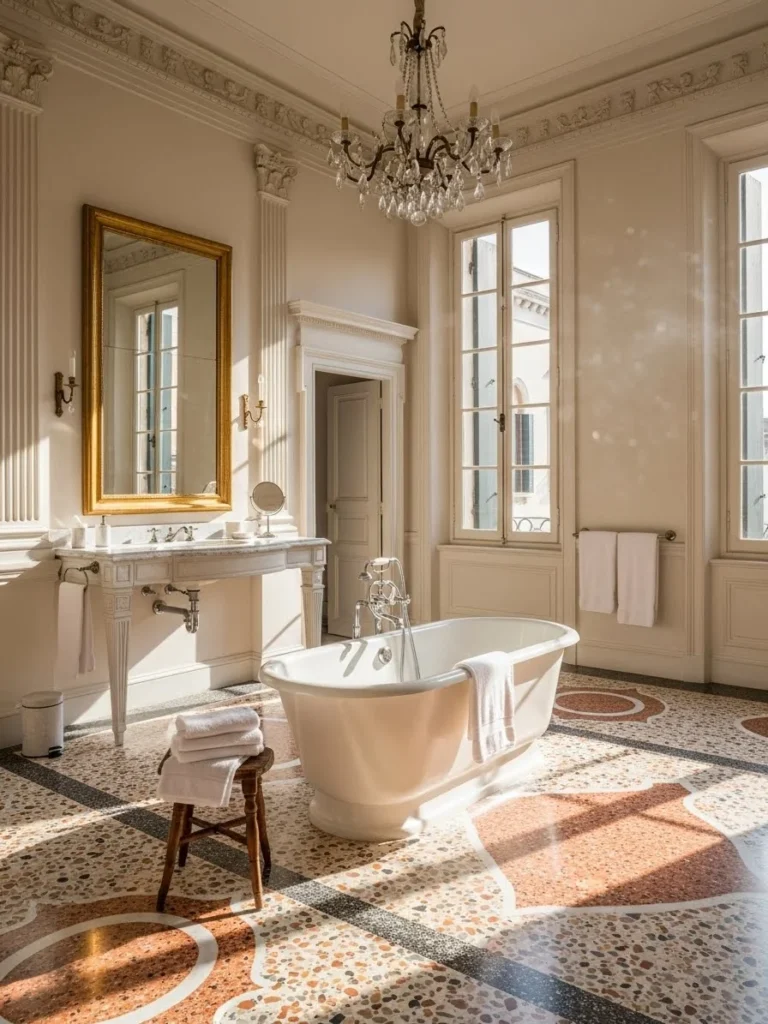
This bathroom takes inspiration from Venetian palazzi, where material durability and surface refinement were essential due to the city’s unique environment. Terrazzo flooring, historically prevalent in Venice, anchors the design with authenticity. Its subtle aggregate provides texture without visual excess.
Walls are finished in polished plaster or stone, reflecting light softly throughout the space. Tall, narrow windows with wooden shutters echo Venetian fenestration, admitting diffused daylight that protects interior finishes. The overall spatial arrangement favors linear progression rather than strict centrality.
Fixtures are understated, often wall-mounted, to preserve floor continuity and visual lightness. Brass and bronze finishes reference maritime trade wealth without ornate embellishment. The bathtub’s form is simple and elongated, aligned parallel to the windows.
The atmosphere is refined rather than grandiose, emphasizing craftsmanship and material longevity. This bathroom reflects Venetian palazzo values—elegance through restraint, technical mastery, and adaptation to place—while remaining historically and architecturally grounded.
Palazzo-Style Bathroom With Baroque Influence
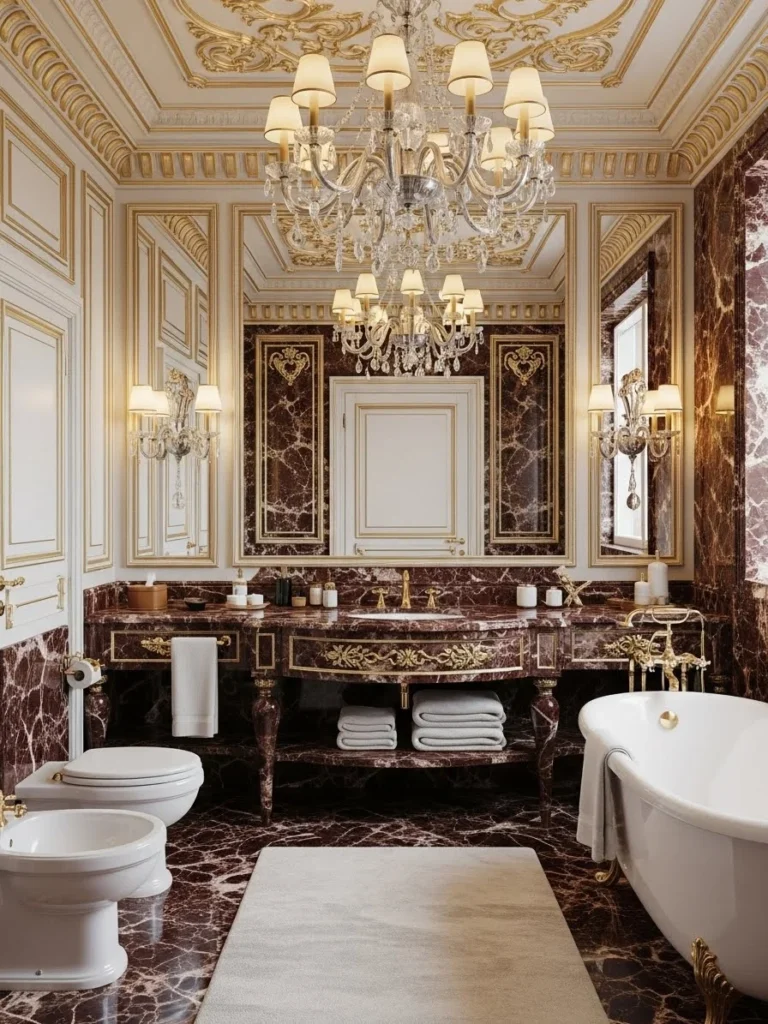
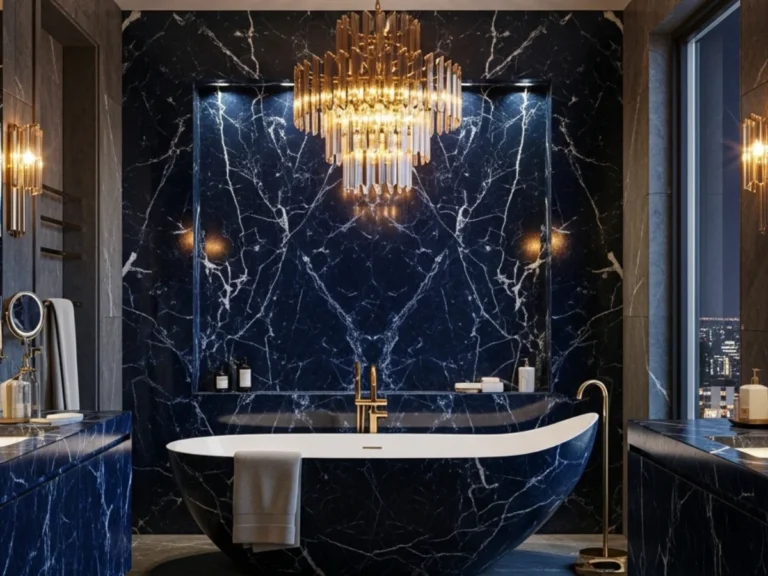
This bathroom reflects the transition from restrained Renaissance order to the expressive richness of the Baroque period as seen in later Italian palazzi. The architectural framework remains classical, but surfaces are animated through deeper moldings, curved profiles, and layered ornamentation. Walls are articulated with pilasters and heavy cornices that create strong shadow lines.
Marble dominates the space, often in darker, more dramatic varieties than earlier Renaissance interiors. Gilded moldings are applied selectively, emphasizing cornices, mirror frames, and architectural junctions rather than covering entire surfaces. The spatial composition remains symmetrical, maintaining classical discipline beneath decorative complexity.
Lighting is theatrical yet controlled, echoing Baroque manipulation of light and contrast. Chandeliers are sculptural but historically informed, inspired by metal and glass fixtures rather than modern crystal excess. Reflections from polished stone amplify depth and richness.
Despite its ornamentation, the bathroom avoids visual chaos through strict proportional logic. The result is an interior that communicates power, ceremony, and sophistication while remaining architecturally coherent and historically grounded in palatial Baroque tradition.
Neo-Classical Palazzo Bathroom
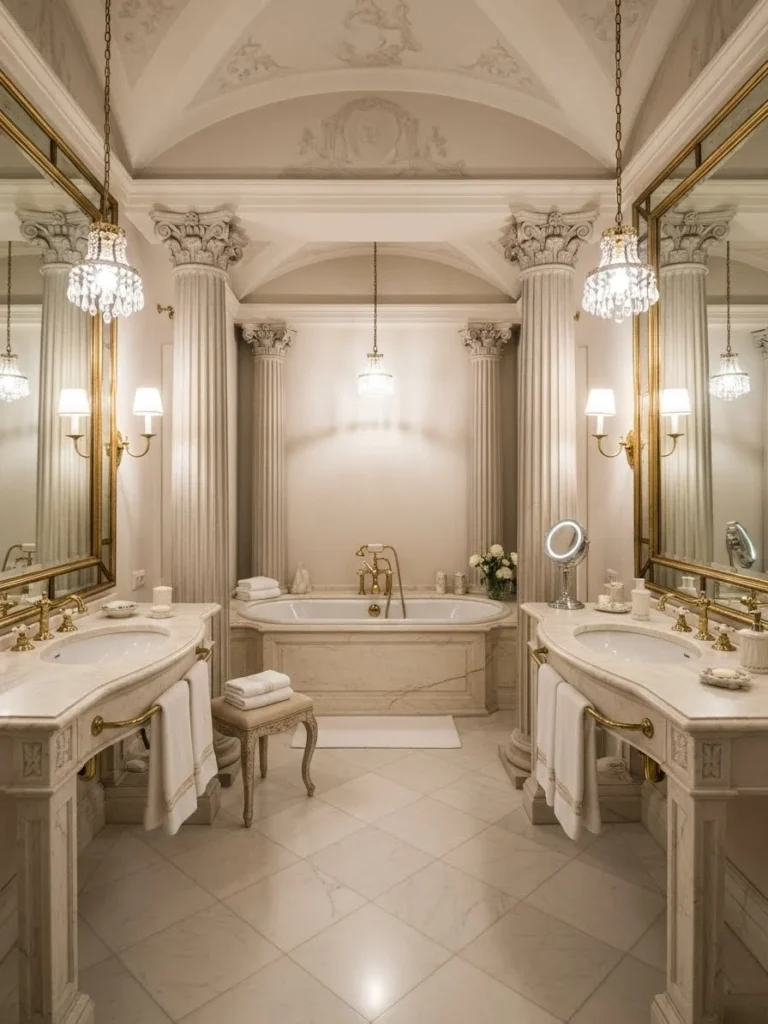
This bathroom draws from the neoclassical revival that reinterpreted ancient Roman ideals with intellectual clarity. The space emphasizes symmetry, measured proportions, and planar surfaces, rejecting excess ornament in favor of architectural logic. Walls are organized through shallow pilasters and restrained paneling.
The material palette is light and disciplined, dominated by ivory, cream, and pale stone. Marble is used with precision, often polished but minimally veined, reinforcing the neoclassical preference for clarity over visual drama. Decorative elements are sparse and carefully scaled.
Fixtures follow simple geometric profiles, inspired by archaeological rediscovery rather than decorative flourish. The bathtub appears as a solid, sculptural volume, recalling Roman stone basins. Hardware finishes are matte or softly polished, avoiding ostentation.
Natural light defines the space, enhancing crisp edges and planar clarity. This bathroom communicates dignity, permanence, and rational beauty, embodying the neoclassical palazzo ideal where luxury is expressed through restraint, order, and architectural purity.
Luxury Italian Palazzo Spa Bathroom With Domed Ceiling
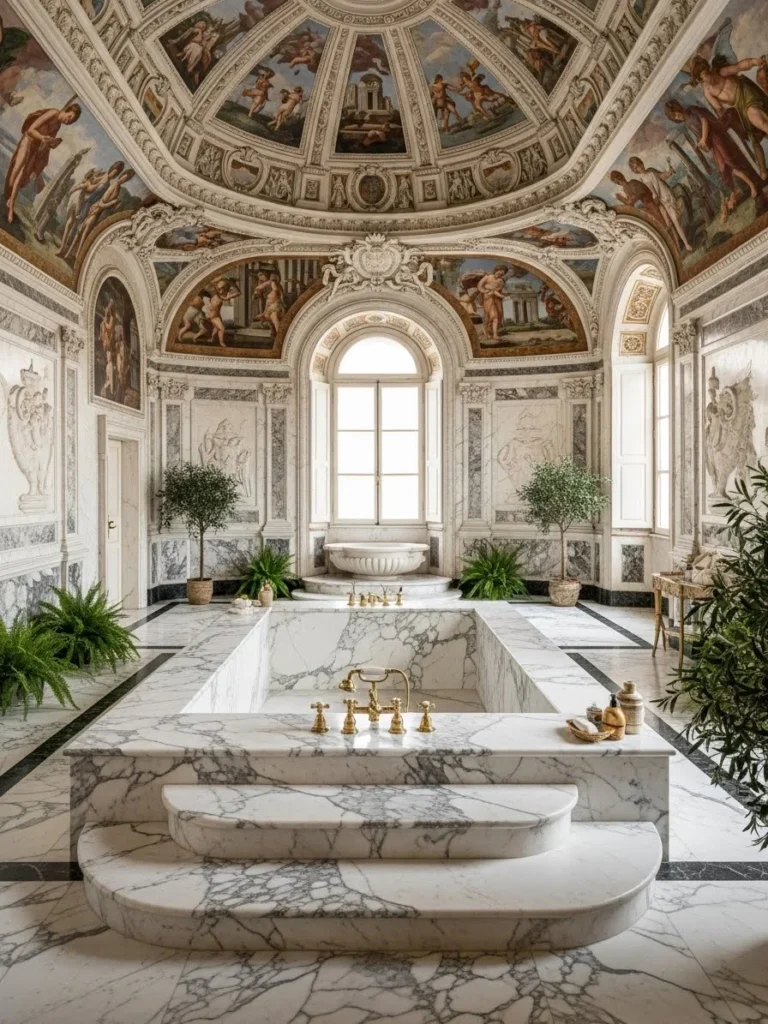
This bathroom centers on a domed ceiling, a form historically associated with sacred and civic architecture adapted for palatial interiors. The dome establishes vertical hierarchy and spatial focus, drawing the eye upward and reinforcing monumentality within a private setting.
Below, the plan remains axial and symmetrical. Walls are constructed of stone or plaster, articulated with shallow niches and classical detailing. The bathing platform is slightly elevated, reinforcing ceremonial importance while maintaining functional clarity.
Marble surfaces are continuous and refined, chosen for structural logic rather than decoration. The bathtub is integrated into the architecture, appearing carved from the floor rather than placed upon it. Fixtures remain minimal, ensuring architectural forms dominate.
Light enters from concealed openings or lanterns within the dome, creating a calm, diffused glow. The atmosphere recalls Roman bath architecture translated through Renaissance palatial principles, offering a historically grounded interpretation of luxury and ritualized bathing.
Renaissance-Inspired Bathroom With Carved Stone Details
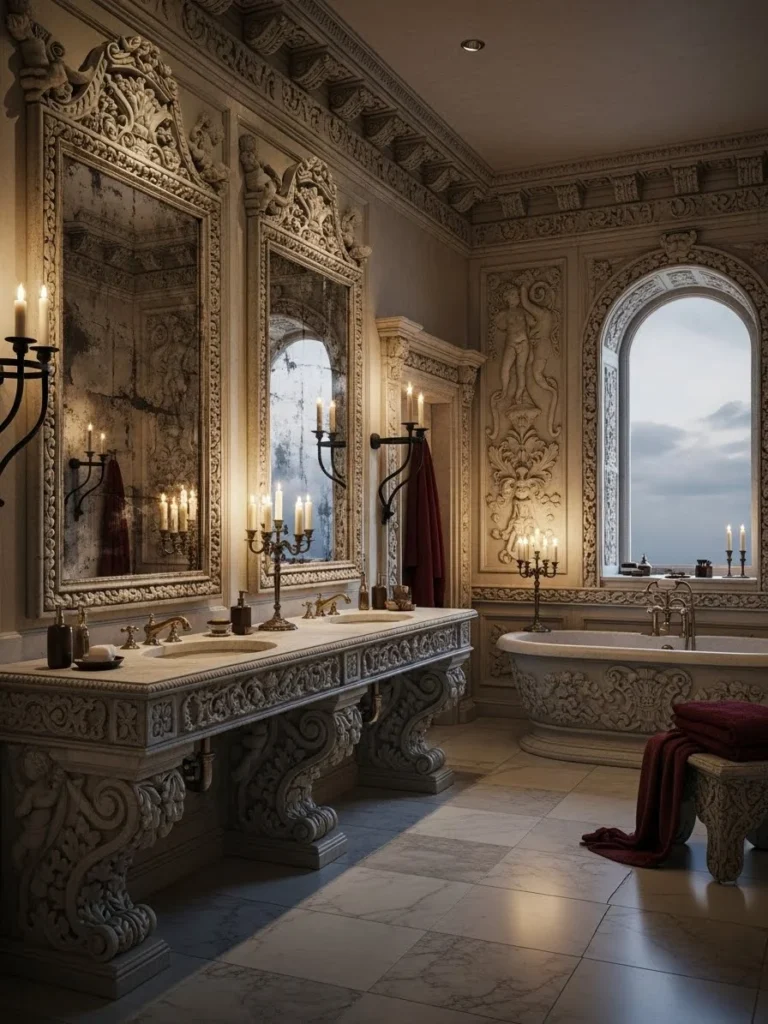
This bathroom is rooted in early Renaissance craftsmanship, where stone carving was both structural and decorative. Architectural details are integral rather than applied, with carved moldings, cornices, and basins forming a unified whole. Proportions follow harmonic ratios derived from classical precedent.
Walls are constructed of stone or finished to resemble masonry, emphasizing solidity and permanence. Ornamentation is limited to areas of functional transition, such as door frames and basin surrounds. These carvings are precise and restrained, reflecting humanist ideals.
Fixtures are inspired by historical metalwork, with visible joints and mechanical honesty. The bathtub resembles a monumental stone vessel, referencing early domestic bathing chambers found in noble residences.
Lighting is subdued and warm, enhancing surface depth and carved relief. The resulting space feels scholarly and timeless, expressing Renaissance values of craftsmanship, intellectual order, and architectural integrity.
Palazzo Bathroom With Grand Arched Doorways
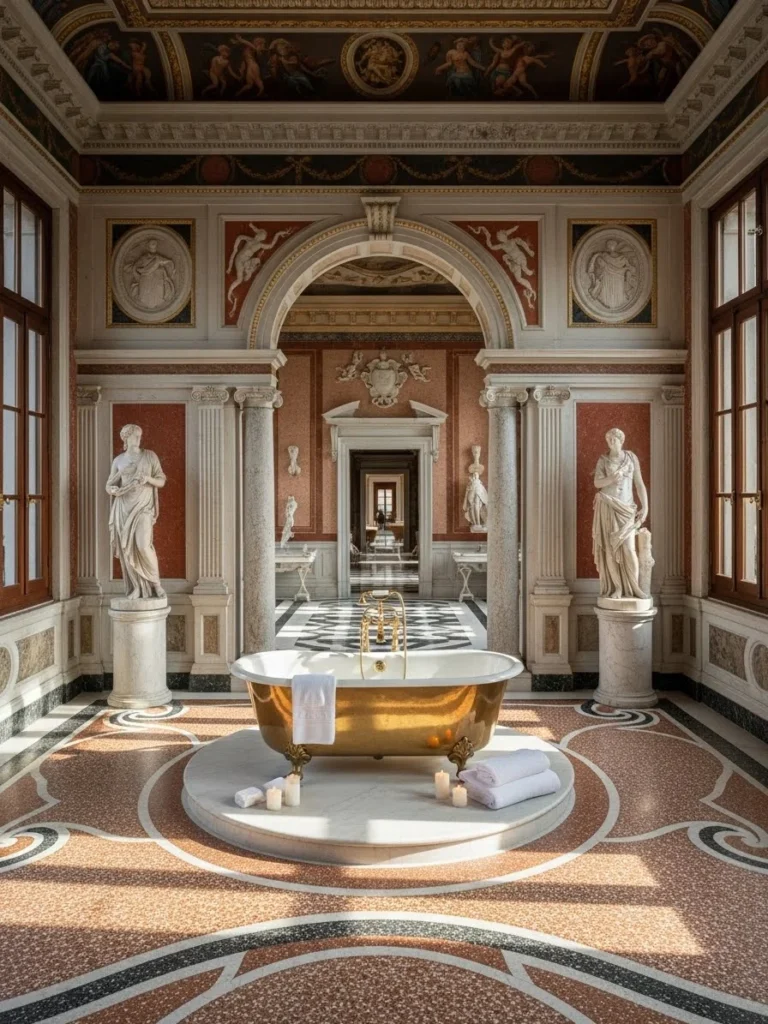
This bathroom emphasizes the architectural importance of arches, a defining feature of Italian palazzi. Doorways are tall and proportionally narrow, framed in stone and aligned along a central axis. These arches define movement and visual hierarchy within the space.
Floors are laid in geometric marble patterns that reinforce directionality and balance. Walls remain largely unadorned, allowing the rhythm of openings to define character. Classical statues or sculptural elements are placed sparingly, reinforcing architectural intent rather than decoration.
The bathtub is positioned to align with the central arch, becoming a focal point framed by architecture. Fixtures are minimal and historically sympathetic, avoiding disruption of spatial continuity.
Light passes through successive arches, creating depth and shadow. This bathroom functions as an architectural sequence rather than a single room, reflecting palatial planning principles where movement, proportion, and spatial progression define luxury.
Ultra-Luxury Palazzo Bathroom Interior
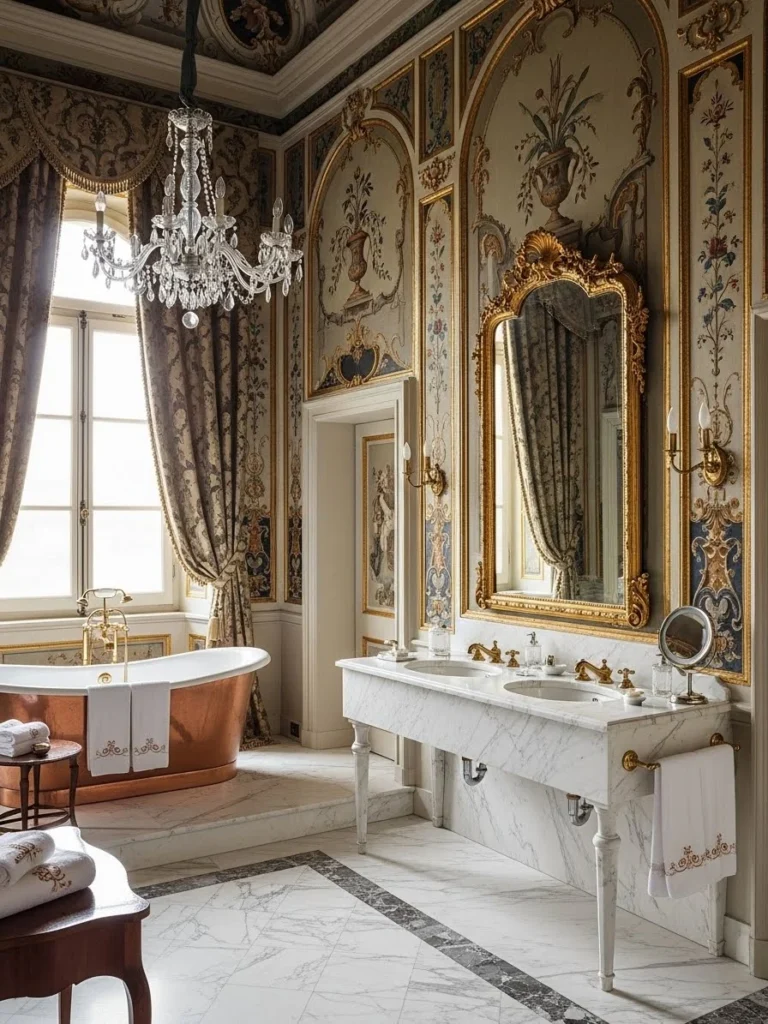
This bathroom represents the culmination of palatial refinement, where craftsmanship, material hierarchy, and architectural clarity define luxury. The space is conceived as part of a noble residence, not an isolated room, and follows strict proportional systems rooted in Renaissance planning principles. Axial alignment and bilateral symmetry organize the layout.
Walls are finished in finely honed marble or smooth lime plaster, articulated with shallow pilasters and restrained cornices. Decorative elements are integrated into the architecture rather than applied, ensuring continuity and permanence. The spatial volume is generous, emphasizing height and depth over surface ornament.
A custom marble vanity and stone bathing vessel recall furniture-like elements historically used in palazzo interiors. Fixtures are minimal, historically informed, and crafted in patinated metal finishes. Their presence supports function without competing with architecture.
Lighting is soft and indirect, designed to reveal material texture and geometry. The atmosphere conveys intellectual luxury, where wealth is expressed through architectural discipline, refined craftsmanship, and timeless material integrity.
Italian Palazzo Bathroom With Floor-To-Ceiling Marble Slabs
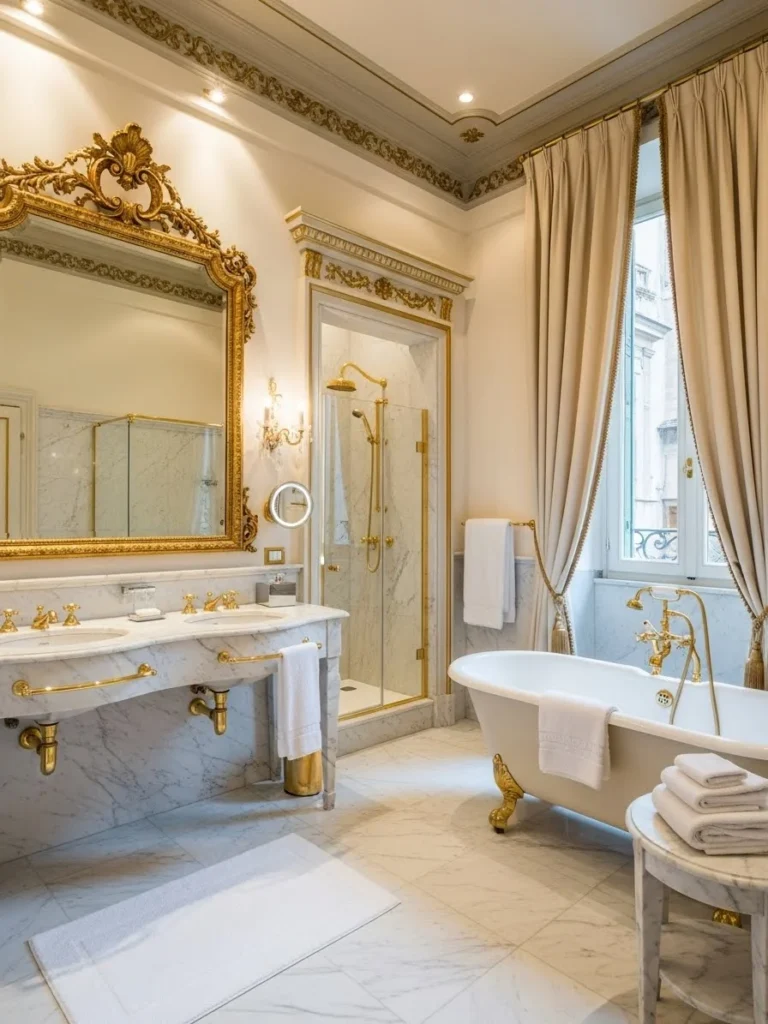
This bathroom emphasizes material continuity through the extensive use of marble, reflecting historical palazzo interiors where stone symbolized permanence and prestige. Floor-to-ceiling slabs create visual unity and reduce decorative fragmentation, allowing natural veining to become the primary ornament.
The architectural framework remains classical, with walls subtly divided through pilasters and recessed panels carved directly into the stone surface. Proportions are carefully calibrated to avoid monumentality overpowering function. Cornices and thresholds are minimal yet precise.
Fixtures are discreet and aligned with architectural axes. Gold leaf detailing is used sparingly at junctions and moldings, referencing historical gilding without excess. The bathtub appears monolithic, as if carved from the surrounding material.
Light interacts with polished stone surfaces, creating soft reflections that enhance spatial depth. This bathroom communicates refined opulence through material mastery and architectural restraint rather than decorative abundance.
Palatial Bathroom Inspired By Roman Villas
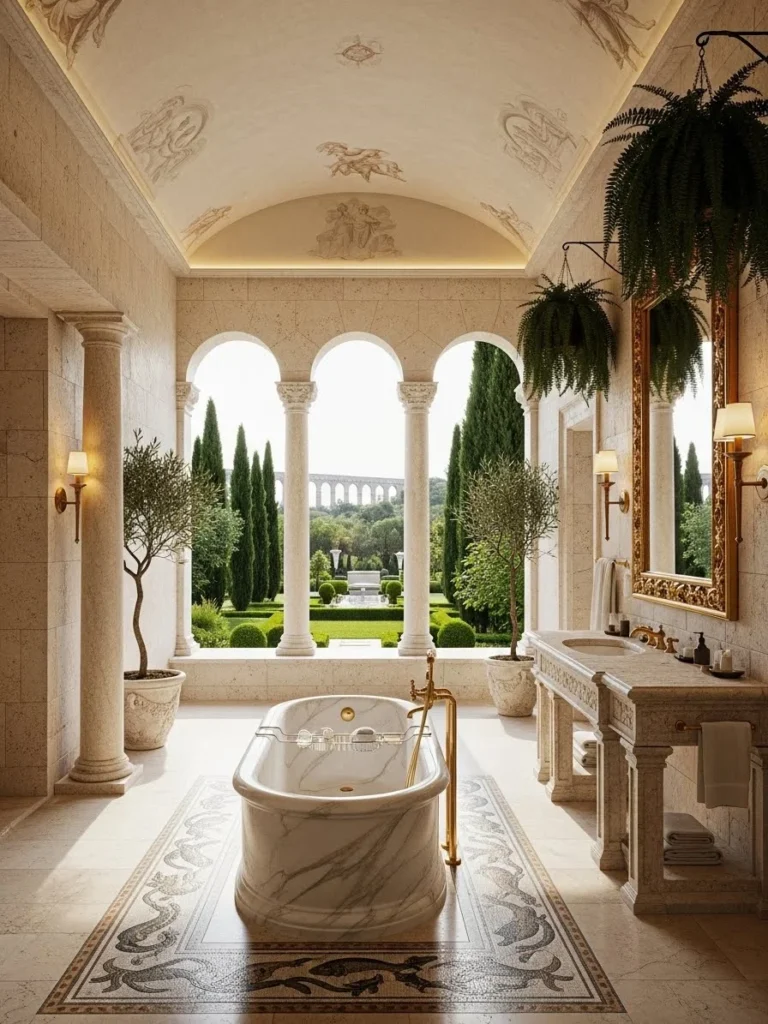
This bathroom draws directly from Roman villa precedents that influenced later Italian palazzi. The plan favors openness and axial clarity, with bathing functions arranged around a central focal point. Architectural forms are solid and grounded, emphasizing structural logic.
Stone surfaces dominate, often left slightly textured to recall Roman construction techniques. Walls are thick and visually weighty, punctuated by arched openings and niches. Decorative elements are minimal and derived from classical vocabulary.
The bathtub recalls Roman immersion basins, broad and low, reinforcing historical continuity. Fixtures are simple and robust, echoing utilitarian Roman metalwork rather than decorative Renaissance refinement.
Natural light enters through loggia-style openings or clerestory windows, creating a connection to the exterior. The space feels serene and monumental, expressing luxury through spatial generosity and historical authenticity.
Opulent Palazzo Bathroom With Dramatic Symmetry
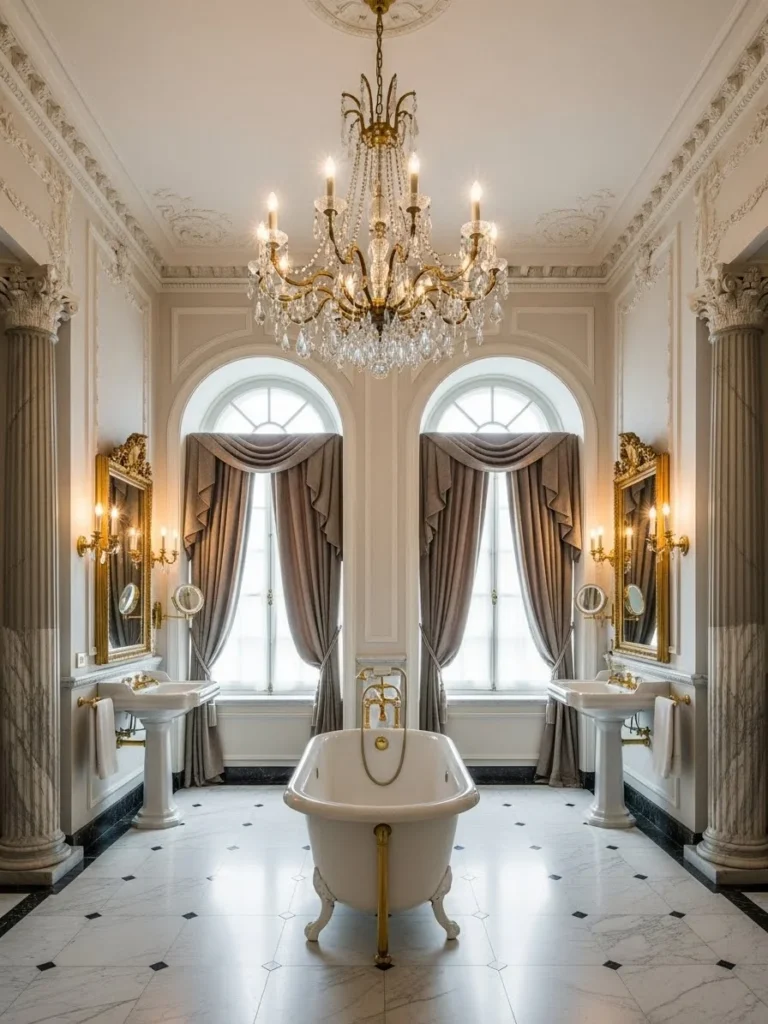
This bathroom is organized around a strong central axis, reflecting the palatial emphasis on order and ceremony. Symmetry governs all elements, from wall articulation to fixture placement, reinforcing visual balance and hierarchy.
Marble floors and walls are laid with precision, often mirroring patterns across the central line. Architectural detailing is consistent and measured, with moldings scaled to the room’s proportions. Decorative restraint ensures clarity.
A freestanding bathtub occupies the central position beneath a classically inspired chandelier. The chandelier references historical metal and glass forms rather than modern crystal extravagance. Fixtures are identical on both sides, reinforcing symmetry.
Lighting enhances balance and depth, with mirrored illumination across the space. The result is a dignified interior where opulence arises from architectural control and spatial discipline.
Luxury Bathroom In A Historic Italian Palazzo
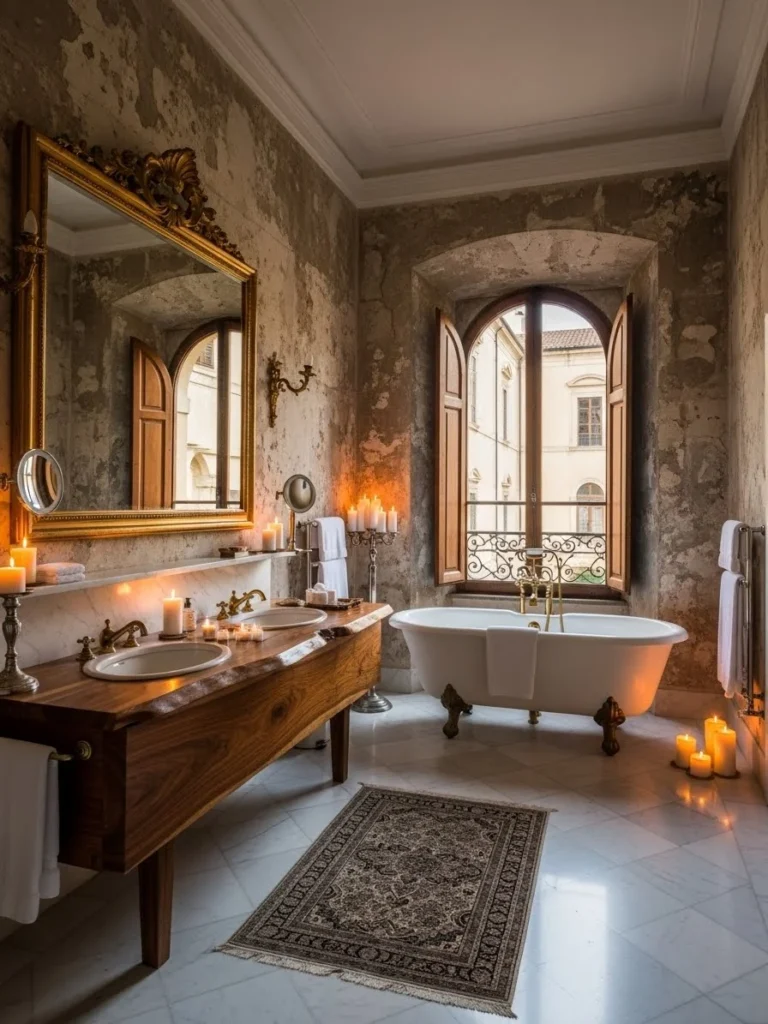
This bathroom is imagined within the fabric of an existing historic palazzo, requiring sensitivity to original architecture. The design preserves wall thicknesses, window proportions, and ceiling heights typical of noble residences.
Original materials such as stone, plaster, and aged marble are respected and restored. New interventions are minimal and reversible, maintaining historical integrity. The spatial layout adapts to existing structural constraints rather than imposing modern planning.
Fixtures are chosen to blend seamlessly with the historic shell, often custom-made to resemble period elements. The bathtub and vanity appear as freestanding objects within an architectural envelope.
Lighting is subtle, highlighting patina and age rather than concealing it. The space communicates continuity, where contemporary comfort coexists with centuries-old architectural character.
Grand Master Bathroom, Palazzo Style
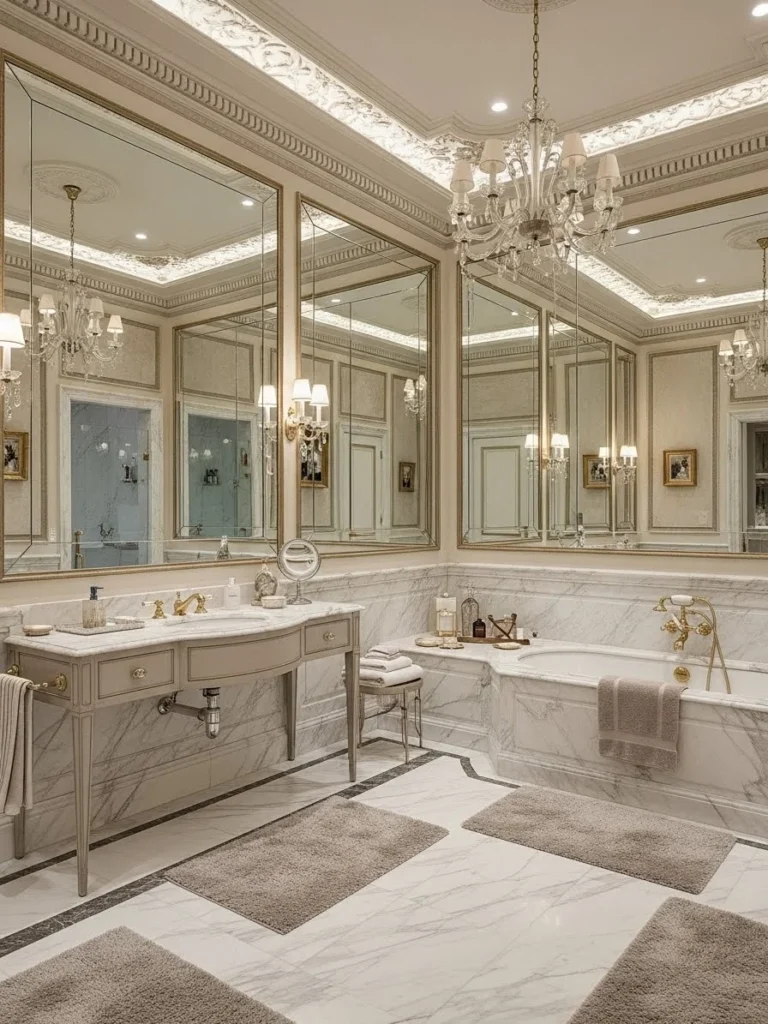
This grand master bathroom is conceived as a principal chamber within a palazzo, reflecting its importance through scale, proportion, and architectural order. The room is organized along a strong central axis, with clear hierarchy between bathing, grooming, and circulation zones.
Walls are articulated with pilasters and deep cornices derived from Renaissance interior detailing. Materials are noble and enduring, primarily marble and stone, used in restrained compositions. Ornamentation is minimal and structurally integrated rather than applied.
Large mirrors are framed within architectural openings rather than decorative frames, reinforcing depth and symmetry. The bathtub is substantial yet understated, positioned to align with architectural geometry. Fixtures are historically sympathetic, with simple profiles and muted metal finishes.
Light enters through tall windows or high openings, emphasizing verticality and rhythm. Artificial lighting is concealed and secondary, preserving the primacy of architecture. The overall atmosphere communicates authority and refinement, consistent with elite European residential tradition.
Palazzo-Style Bathroom With Sculptural Stone Bathtub
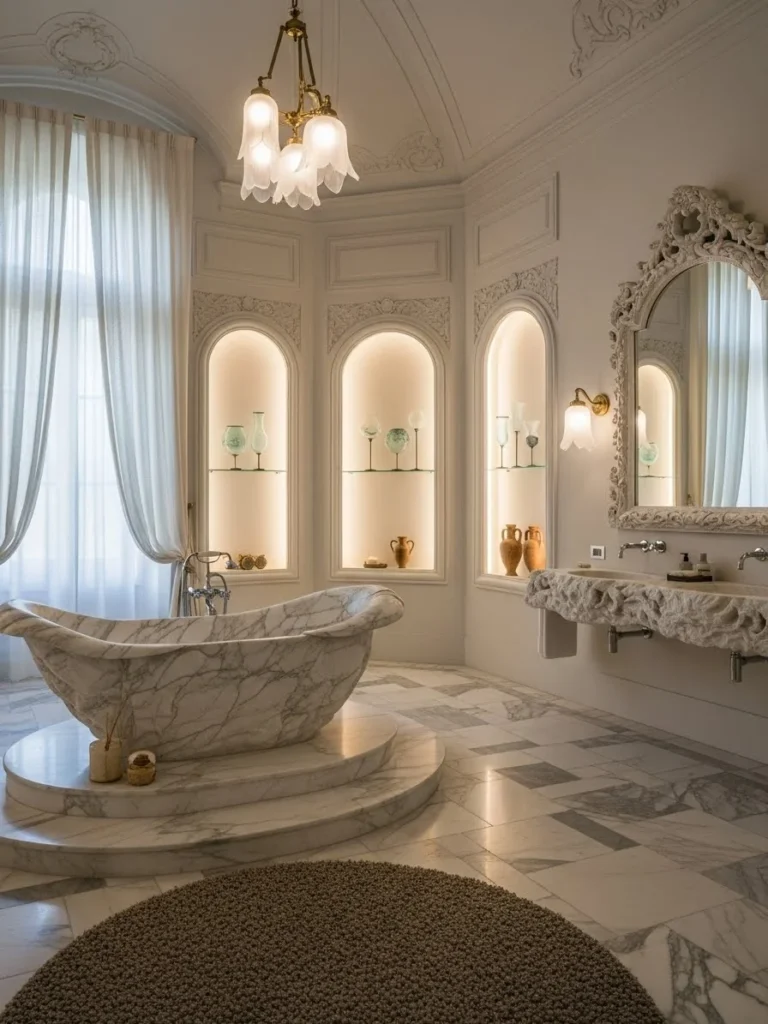
This bathroom is organized around a sculptural stone bathtub, treated as a permanent architectural element rather than a movable fixture. The tub recalls carved stone basins found in historic palazzi, emphasizing weight, solidity, and craftsmanship.
Walls are restrained and planar, allowing the bathtub to remain visually dominant. Stone or plaster surfaces are articulated through subtle joints and reveals rather than decoration. Niches are integrated into the walls for functional storage.
The spatial layout maintains symmetry and axial alignment, ensuring visual calm. Fixtures are minimal, often wall-mounted, and finished in patinated metals that complement the stone. Their design avoids contemporary stylization.
Lighting is directed to emphasize form and texture, revealing the bathtub’s carved surfaces. The resulting space feels contemplative and timeless, expressing luxury through material permanence and architectural clarity.
Baroque Palazzo Bathroom Interior
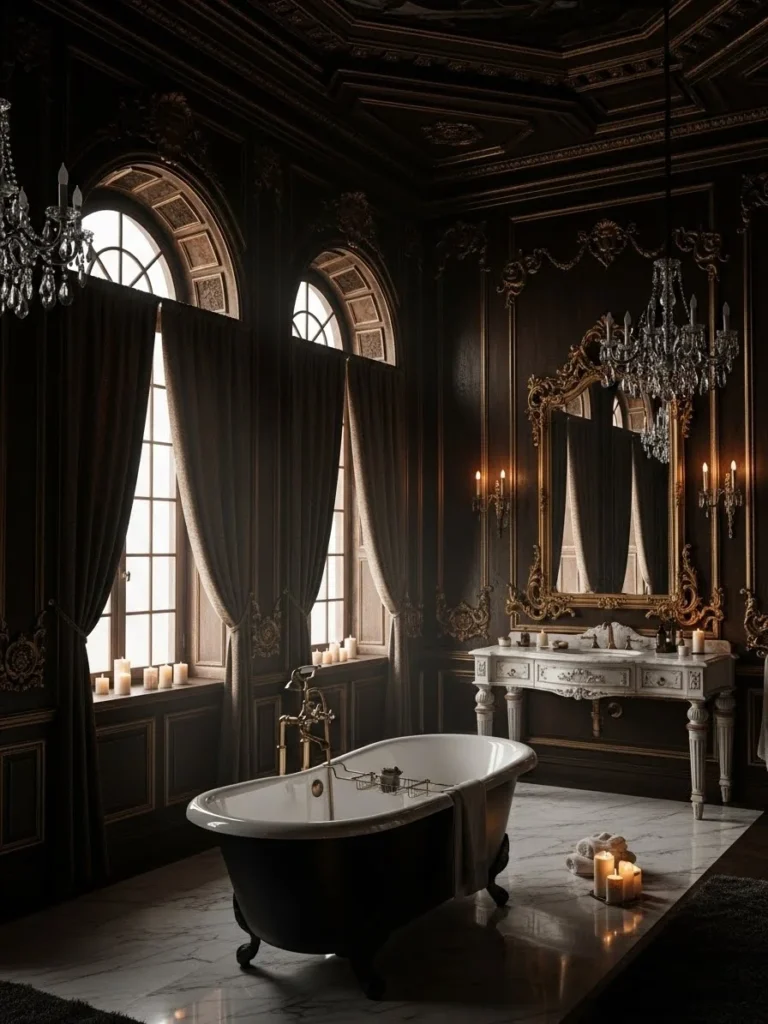
This bathroom reflects Baroque palatial interiors, where architecture was designed to impress through movement, depth, and controlled ornamentation. Curved surfaces, layered moldings, and dramatic cornices define the spatial character.
Marble is used extensively, often in contrasting tones to enhance visual drama. Gilded detailing highlights key architectural elements such as cornices and mirror surrounds. Despite richness, symmetry and proportion remain disciplined.
Fixtures echo Baroque metalwork traditions, featuring subtle curvature and decorative profiles. The bathtub is centrally placed, often framed by architectural elements to create a sense of theatrical focus.
Lighting emphasizes contrast, using shadow to enhance depth and ornament. The space feels ceremonial and expressive, grounded in historical precedent rather than decorative excess.
Italian Palazzo Spa Bathroom With Indoor Fountain
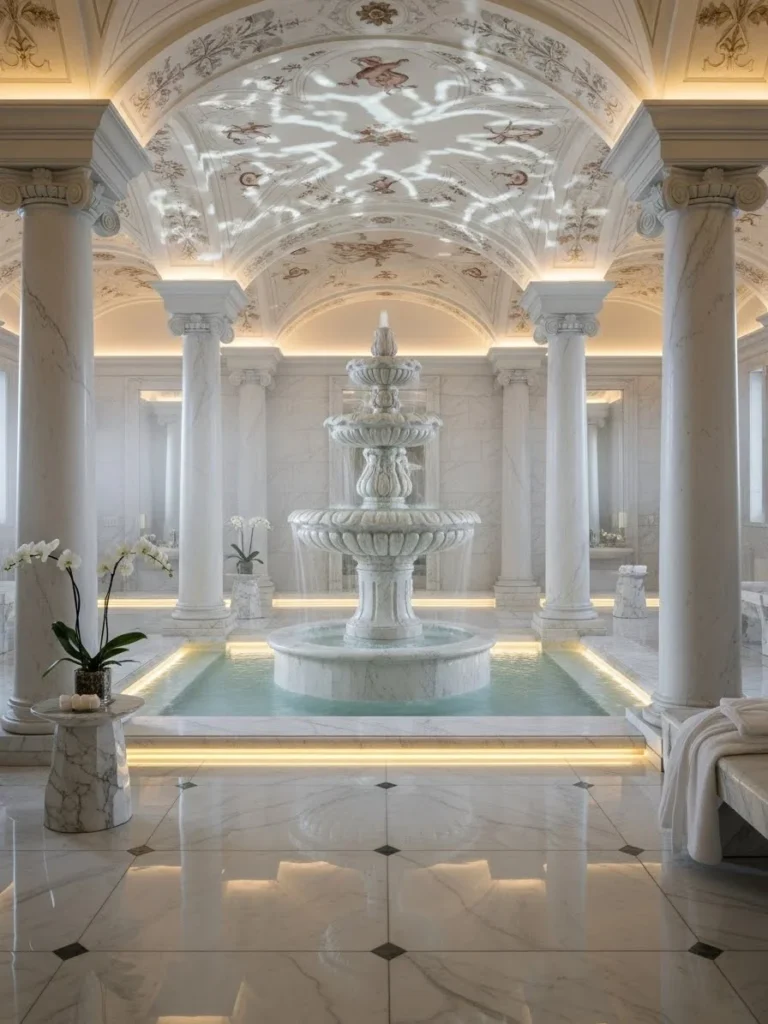
This bathroom integrates an indoor fountain, drawing from Renaissance and Roman traditions where water was both functional and symbolic. The fountain acts as a spatial anchor, organizing surrounding bathing elements.
Stone surfaces dominate, with textured finishes that respond to moisture and light. Walls are thick and articulated with niches and arches, reinforcing palatial solidity. Ornamentation remains architectural rather than applied.
The bathtub is positioned in relation to the fountain, maintaining axial clarity. Fixtures are minimal and historically inspired, allowing the sound and movement of water to define atmosphere.
Natural light enhances reflections and movement, creating a tranquil environment. The space evokes ritual, leisure, and refinement consistent with historic spa traditions.
Luxury Palazzo Bathroom Featuring Checkerboard Marble Flooring
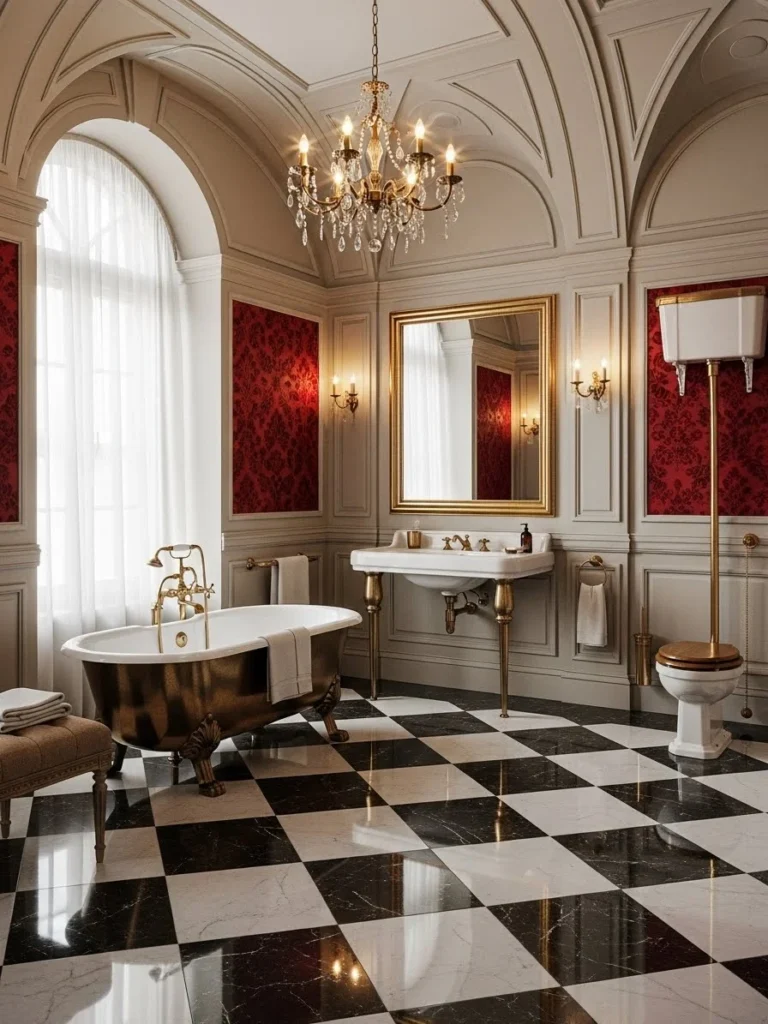
This bathroom uses checkerboard marble flooring as a defining architectural feature, historically associated with palatial and ecclesiastical interiors. The pattern establishes rhythm and spatial order.
Walls remain restrained to avoid competing with the floor. Classical articulation is achieved through pilasters and cornices rather than surface ornament. The overall composition is balanced and deliberate.
Fixtures are aligned with the grid of the floor, reinforcing architectural logic. The bathtub is centered within the pattern, becoming a focal point without overpowering the space.
Light enhances contrast between marble tones, emphasizing geometry. The result is a dignified interior that communicates luxury through proportion, material quality, and architectural discipline.
Classic Palazzo Bathroom Design With Fresco Murals
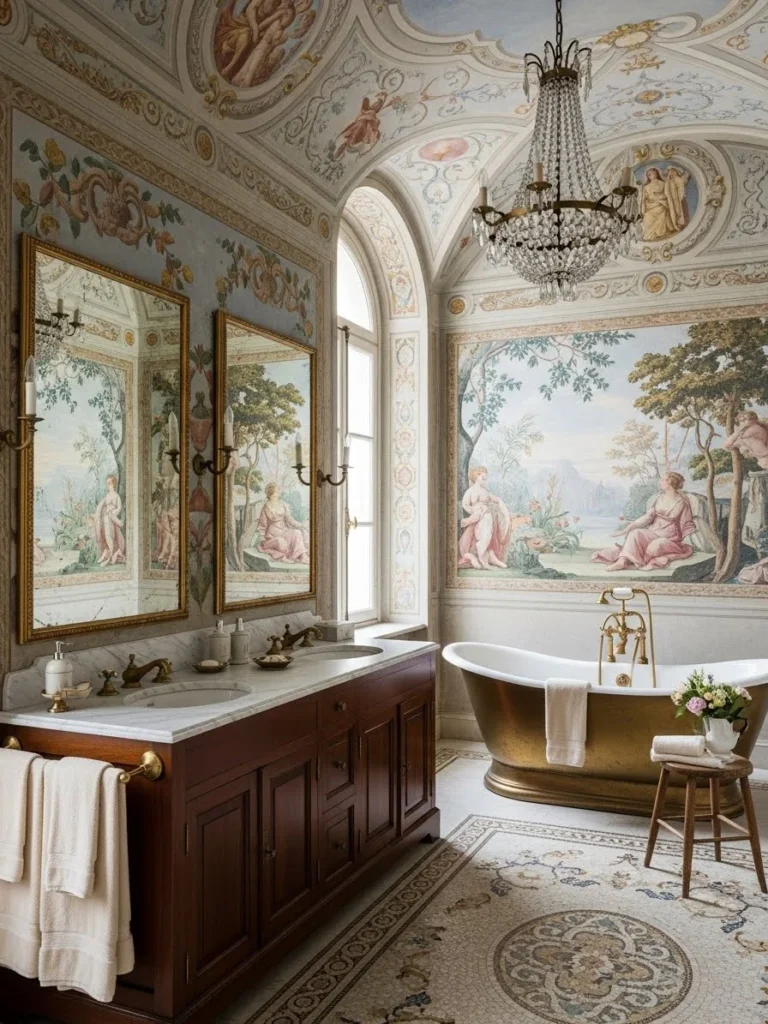
This bathroom draws from the tradition of fresco murals commonly found in Italian palazzi, where painted surfaces extended architectural space. The walls serve as canvases for restrained fresco work, featuring architectural illusions, ornamental motifs, or classical narratives executed in muted tones.
Architectural elements remain disciplined to support the painted surfaces. Walls are finished in lime plaster, while cornices and pilasters provide subtle framing. The floor is typically stone or marble, chosen for durability and visual calm.
Fixtures are minimal and carefully integrated, avoiding disruption of the mural compositions. Vanities resemble stone consoles, and the bathtub is positioned to preserve clear sightlines. Metals are subdued, reflecting historical material palettes.
Lighting is indirect and carefully controlled to protect painted surfaces. The atmosphere recalls palatial reception rooms adapted for private use, blending artistic heritage with functional comfort.
Ultra-Detailed Palazzo Bathroom Render
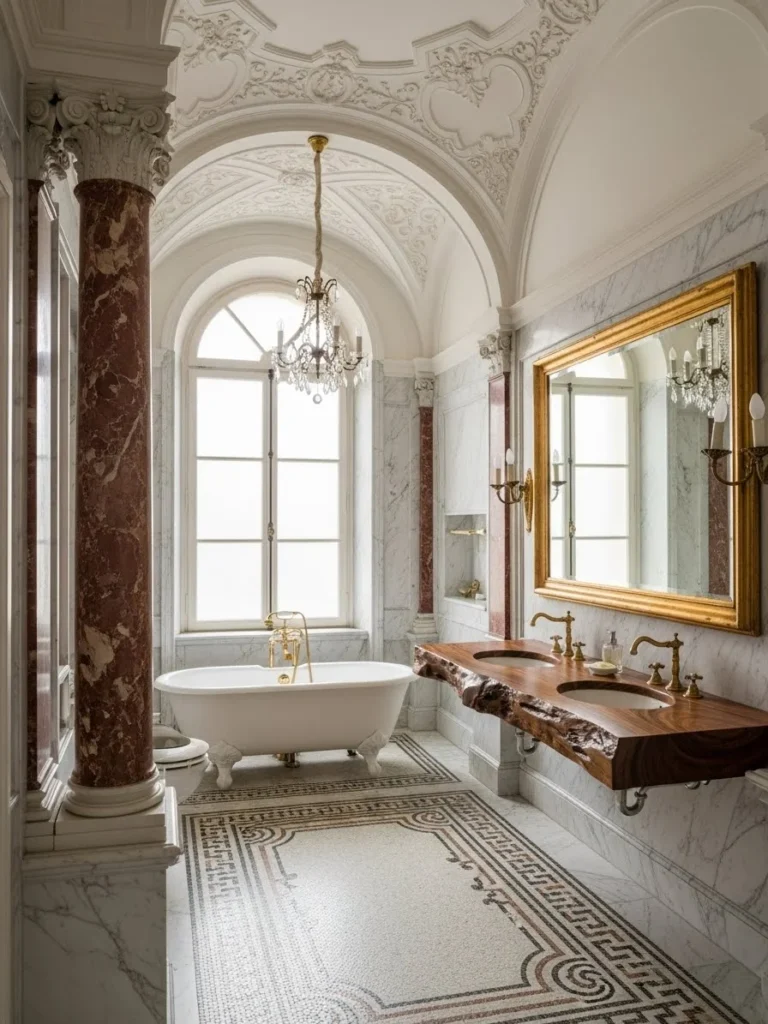
This bathroom emphasizes architectural accuracy and material realism, presenting the space as a scholarly reconstruction rather than a stylized interpretation. Proportions follow Renaissance palazzo standards, with emphasis on height, symmetry, and axial alignment.
Materials are rendered with precision, including stone, plaster, and marble, each with historically correct finishes. Wall articulation is restrained, relying on geometry rather than ornament. The spatial composition is calm and deliberate.
Fixtures are designed to appear permanent, integrated into the architectural shell. The bathtub and vanity read as stone elements rather than furniture. Metal finishes are muted and historically appropriate.
Light is naturalistic, entering from tall openings and enhancing texture. The result is an academically grounded visualization of palatial luxury rooted in architectural authenticity.
Italian Palazzo Bathroom With Arched Marble Shower
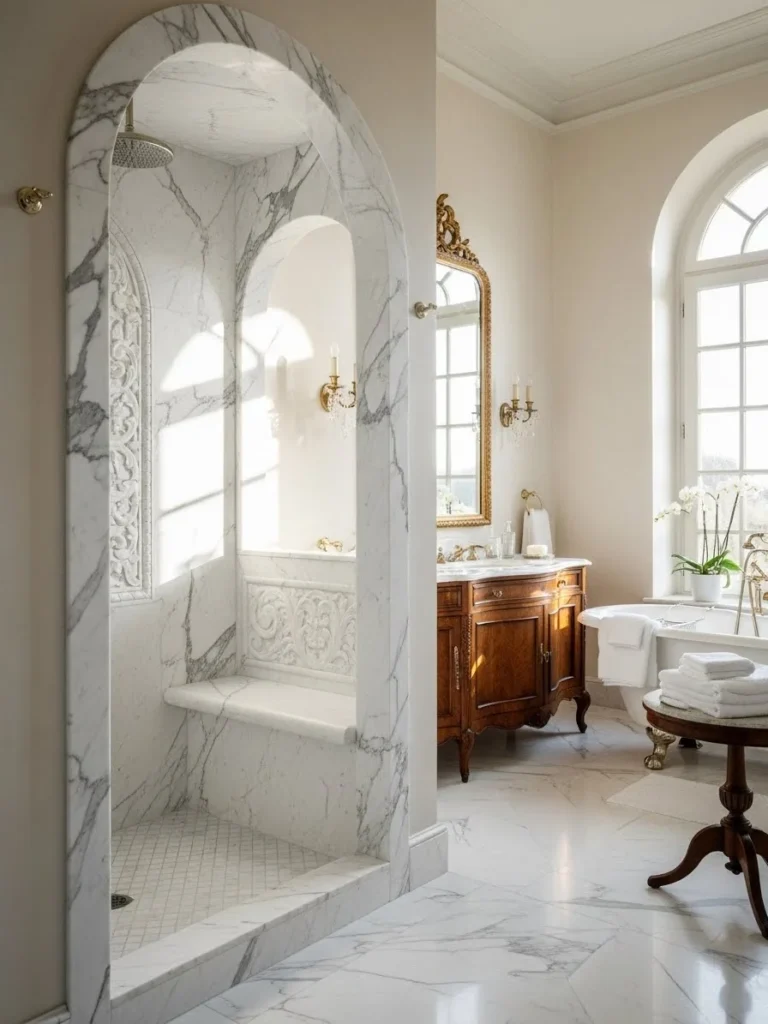
This bathroom incorporates an arched marble shower, referencing the architectural language of palazzi and Roman baths. The arch establishes hierarchy and frames the bathing function with architectural dignity.
Marble is used structurally, forming walls, benches, and thresholds. The surface treatment is honed rather than polished, ensuring visual softness and historical accuracy. Decorative elements remain minimal.
Fixtures are recessed or wall-mounted to preserve the clarity of the arch. Their profiles are simple and robust, consistent with historic metalwork traditions. The shower becomes a spatial volume rather than a contemporary enclosure.
Light interacts with the curved surfaces, enhancing depth and rhythm. The space communicates permanence, functionality, and architectural refinement.
Regal Palazzo Bathroom With Symmetrical Vanities
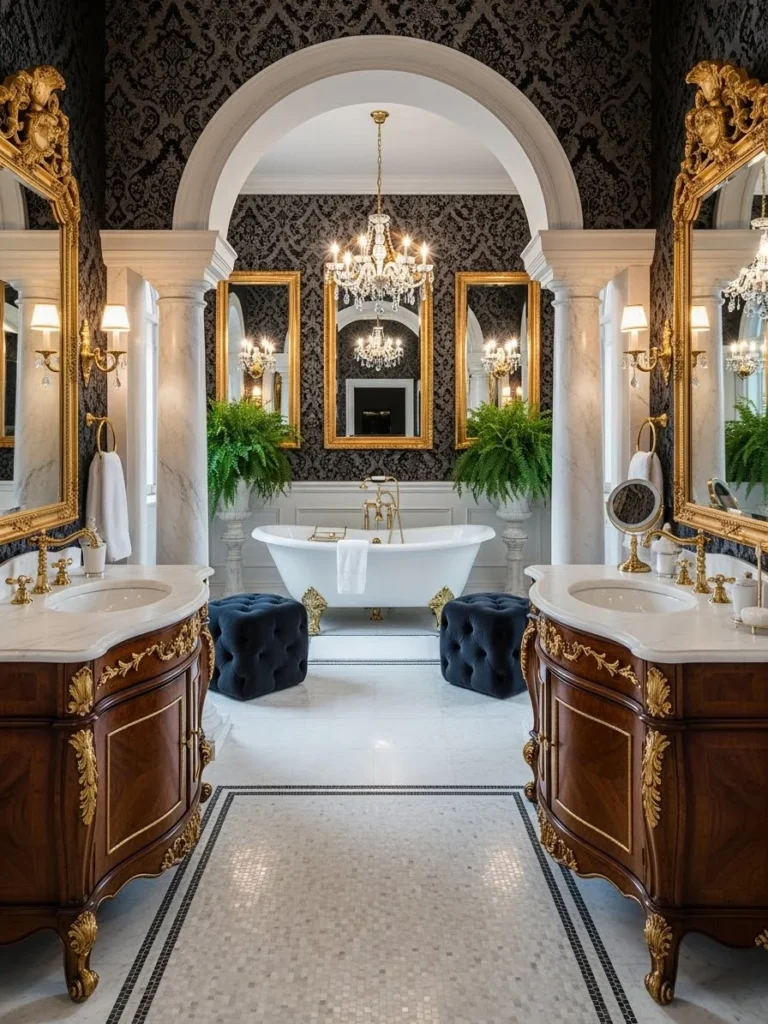
This bathroom is defined by bilateral symmetry, a key principle of palatial planning. Twin vanities are positioned opposite one another, reinforcing balance and hierarchy within the space.
Walls are articulated with pilasters and framed openings, maintaining rhythm and order. Materials are noble and durable, typically marble and stone. Ornamentation is restrained and proportional.
Vanities resemble stone consoles rather than cabinetry, reinforcing permanence. Fixtures are identical on both sides, finished in patinated metals that align with historic precedent.
Lighting is mirrored across the central axis, enhancing symmetry. The atmosphere is formal and dignified, reflecting aristocratic domestic traditions.
Palazzo-Style Luxury Bathroom Inspired By Florence Estates
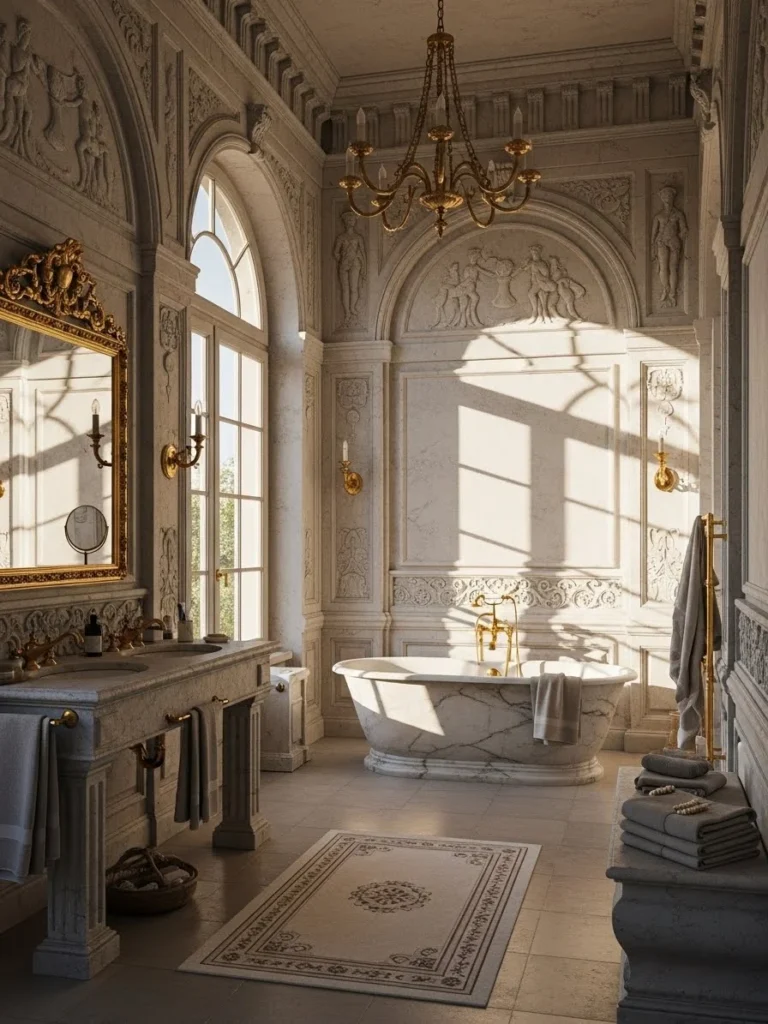
This bathroom reflects Florentine palazzo traditions, emphasizing intellectual restraint and material quality. Proportions are carefully controlled, avoiding excess in favor of architectural clarity.
Stone and marble dominate, often in warm, muted tones. Walls are plastered or clad in stone, articulated through simple moldings. The spatial composition is calm and ordered.
Fixtures are understated and integrated into the architecture. The bathtub is sculptural yet restrained, referencing carved stone forms. Metals are subdued and functional.
Light enters through tall windows, enhancing texture and depth. The resulting space embodies Florentine ideals of disciplined luxury and craftsmanship.
Historic Palazzo Bathroom Blended With Modern Luxury
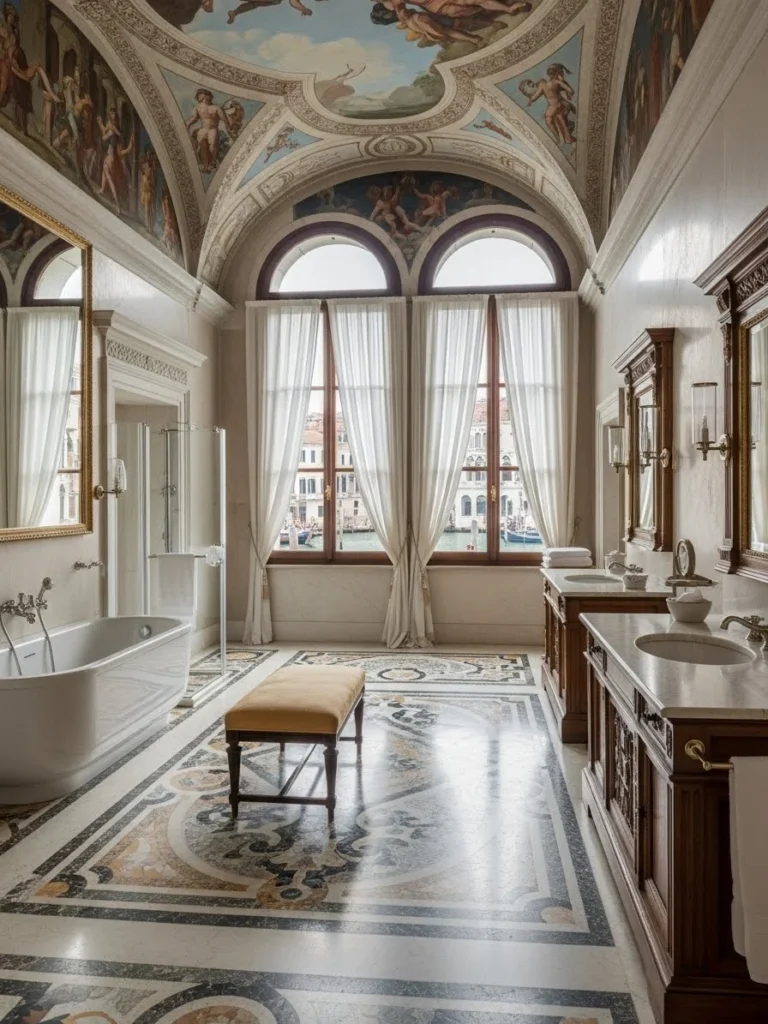
This bathroom is conceived within a historic palazzo shell while discreetly accommodating contemporary comfort. The original architectural fabric remains dominant, with thick masonry walls, traditional window proportions, and preserved ceiling heights guiding the design.
New elements are inserted carefully, avoiding visual competition with the historic structure. Stone and plaster surfaces remain continuous, while modern fixtures are recessed or concealed. The spatial organization respects original circulation patterns.
The bathtub and vanity appear as freestanding stone elements, echoing historical precedents while meeting modern performance standards. Metals are muted and refined, ensuring visual compatibility with aged materials.
Lighting is integrated subtly, highlighting texture and patina without altering the character of the space. The result is a respectful dialogue between historical authenticity and modern function.
Grand Italian Palazzo Bathroom
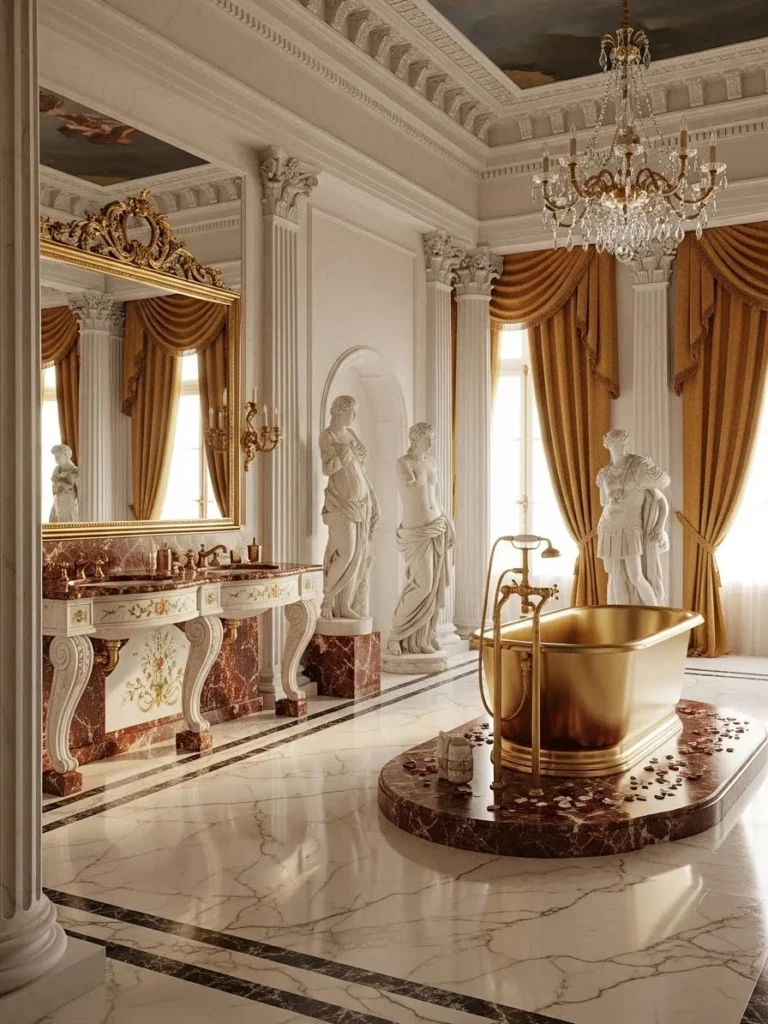
This bathroom expresses palatial grandeur through scale and architectural clarity rather than ornament. The space is expansive, with high ceilings and long sightlines that reinforce monumentality.
Stone floors and walls establish permanence, while classical articulation defines rhythm and proportion. Decorative elements are minimal and structurally integrated. The spatial composition emphasizes symmetry.
The bathtub occupies a central or axial position, reinforcing hierarchy. Fixtures are restrained, historically inspired, and visually secondary to architecture.
Light enters generously, revealing material depth and reinforcing spatial order. The atmosphere is dignified and authoritative, reflecting noble residential tradition.
Luxury Palazzo Bathroom With Domed Skylight
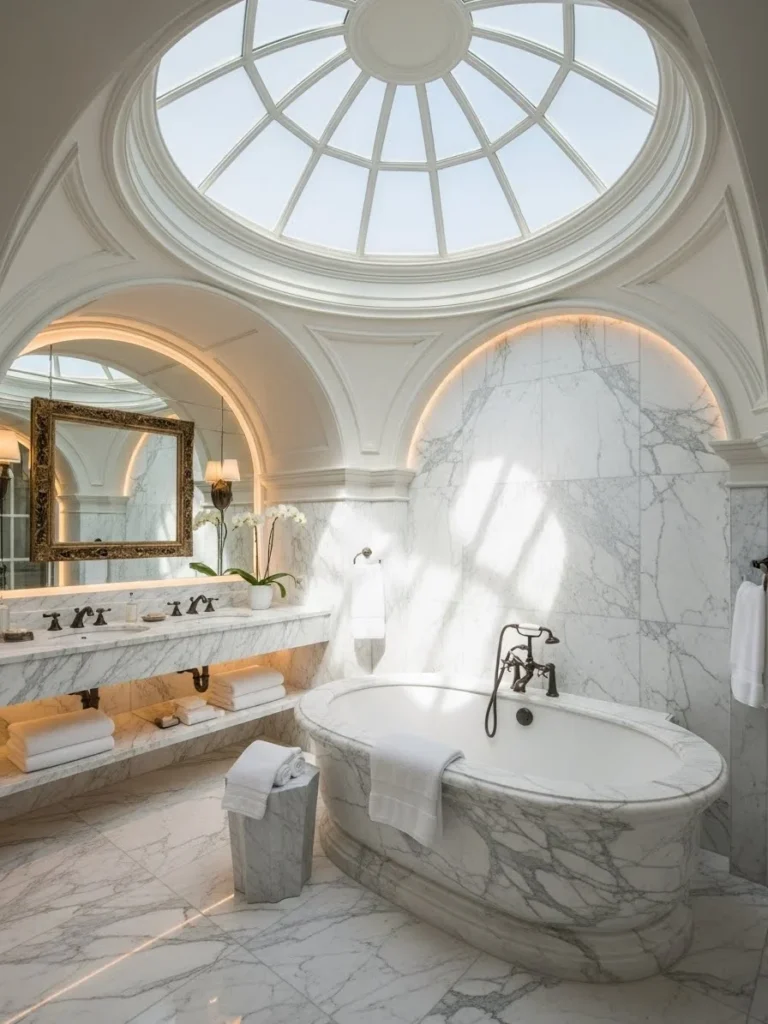
This bathroom centers on a domed skylight, a form derived from Roman and Renaissance architecture. The skylight introduces natural illumination from above, creating a calm and evenly lit environment.
The plan remains symmetrical, with bathing elements organized around the vertical axis. Walls are articulated with classical detailing, scaled to the room’s proportions.
Marble and stone surfaces are continuous and refined. The bathtub is positioned directly beneath the skylight, reinforcing spatial focus. Fixtures are discreet and minimal.
Light changes throughout the day, animating surfaces and enhancing architectural form. The space feels serene and monumental, rooted in historical precedent.
Timeless European Palazzo Bathroom
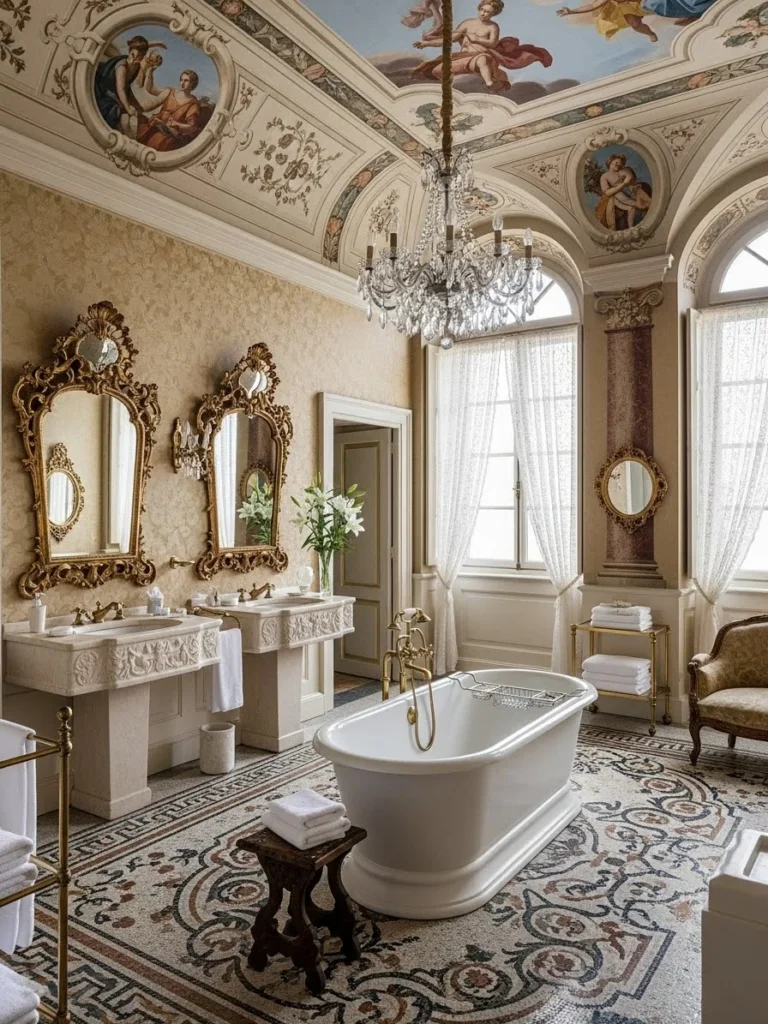
This bathroom is designed to appear outside of time, grounded in enduring architectural principles rather than stylistic trends. Proportions are harmonious, and spatial organization is clear and logical.
Materials are noble and durable, including stone, plaster, and marble. Ornamentation is minimal and architectural in nature, ensuring longevity.
Fixtures are integrated seamlessly, avoiding visual dominance. The bathtub and vanities resemble permanent stone elements rather than furniture.
Light is soft and natural, enhancing texture and calm. The atmosphere reflects quiet luxury and intellectual refinement.
High-End Palazzo Bathroom Interior Visualization
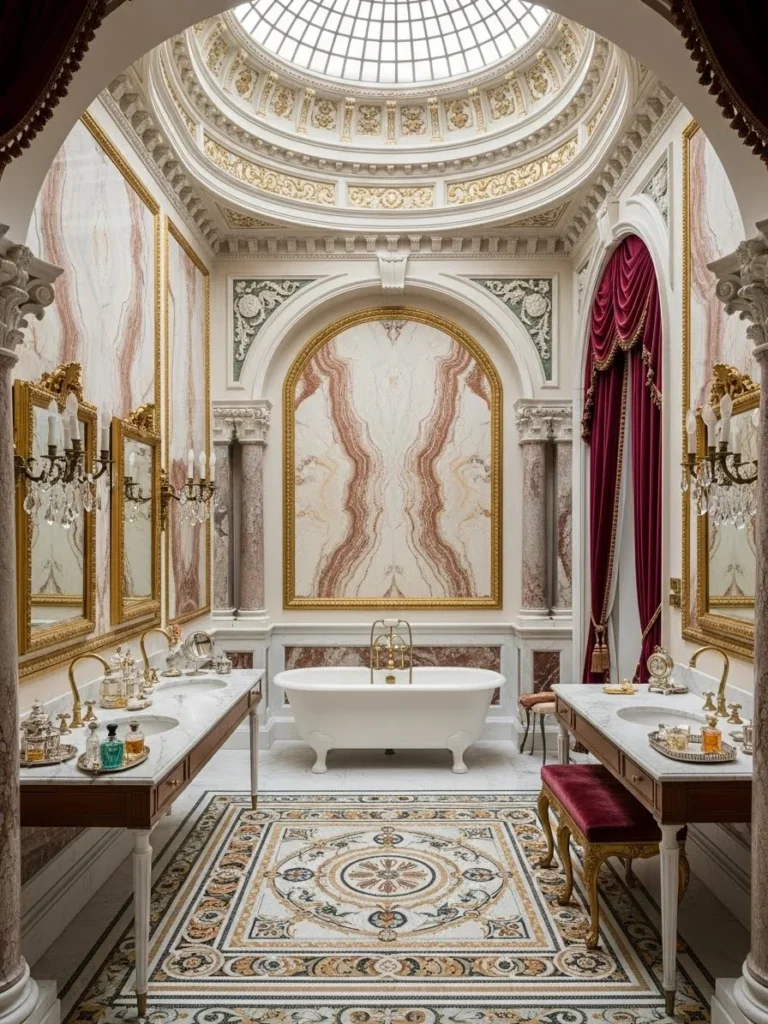
This bathroom serves as an academically informed visualization of palatial bathing spaces. Architectural accuracy guides every decision, from proportions to material selection.
Walls, floors, and ceilings are rendered with historically correct finishes. Classical articulation is precise and restrained. Spatial hierarchy is clear.
Fixtures are designed as architectural components rather than decorative objects. Metals are muted, reinforcing authenticity.
Lighting replicates natural conditions, revealing texture and form. The final space communicates scholarly luxury rooted in European palatial tradition.